Category 13 / 14Food acids, preservatives & pharma materials
Pharma, Food & Specialty Chemicals
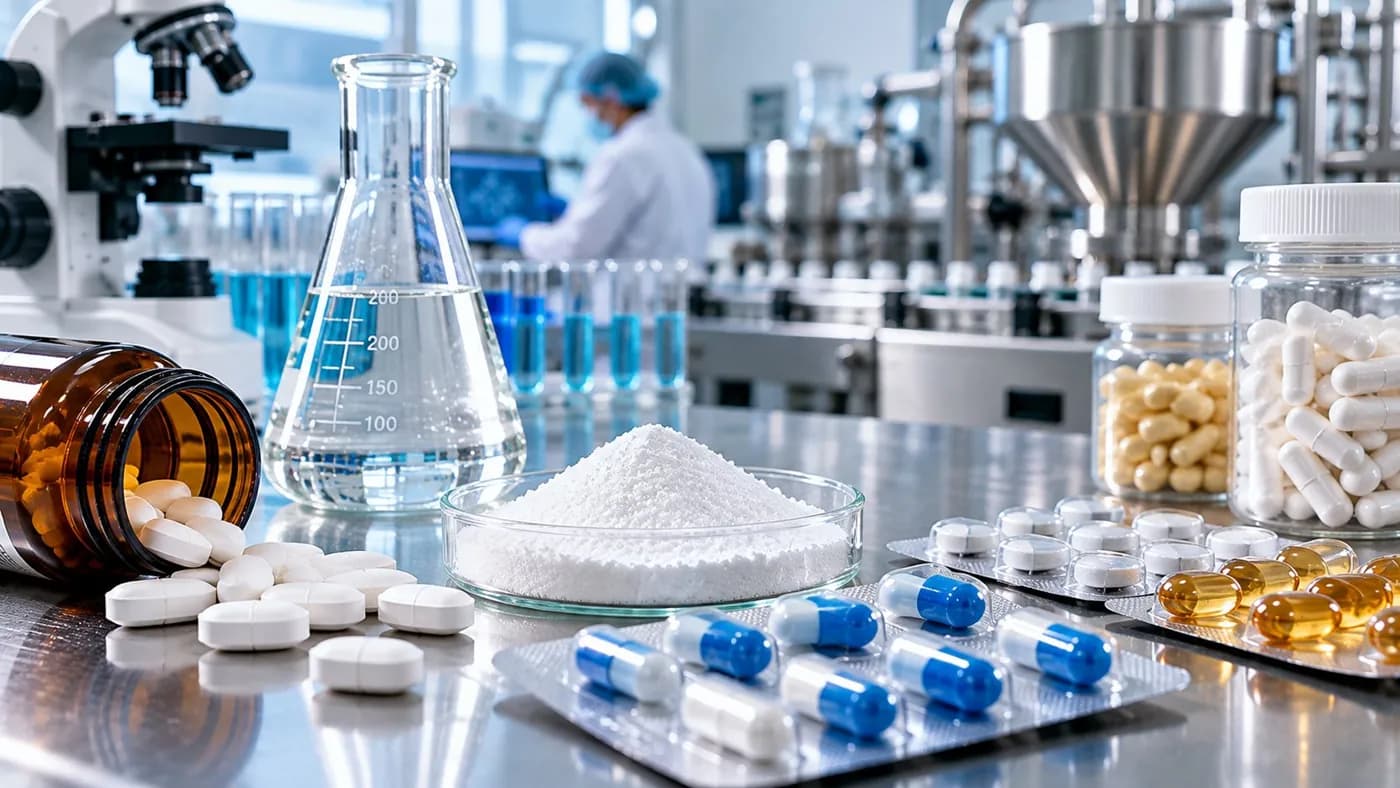
We source food acids, preservatives, antioxidants and sweeteners, pharma polymers such as povidone, mineral and vitamin ingredients, and pregabalin materials for food, beverage, nutraceutical, pharmaceutical and personal care manufacturers, with grade and documents confirmed for each requirement.
- Products
- 32
- Product groups
- 1
- Industries served
- 4
- Order size
- Trial bag to tanker
Ingredients for health and taste
This range covers the functional ingredients that set taste, shelf life and dosage form. Citric acid (monohydrate and anhydrous), malic, lactic, fumaric and L- and DL-tartaric acids acidulate drinks, confectionery and effervescent tablets; potassium sorbate, sodium benzoate and calcium and sodium propionate control moulds and yeasts; BHA and TBHQ slow oxidative rancidity in oils and snacks; and sucralose sweetens without sugar.
For pharmaceutical and nutrition formulators there are the povidone grades PVP K30 and PVP K90 as binders and solubilisers, benzoyl peroxide (micronised IP for topical products, granules as a polymerisation initiator), calcium gluconate, potassium citrate, ascorbic acid, folic acid and iron sources such as ferrous fumarate, ferrous ascorbate and ferric ammonium citrate. Pregabalin API is offered with its intermediates CMH and RCMH, alongside denatonium benzoate, the bittering agent used to deter accidental swallowing.
Food, pharma and feed uses each call for a specific grade and paperwork. Lithionyx confirms the grade, specification and documents for your application before quoting, and shares the manufacturer's COA and SDS with every batch.
32 products in this range
Each listing has its own page with CAS number, typical use and documents. Ask for a quote on one product or send your full requirement.
- CAS 9003-39-8
PVP K30
Tablet binder, solubiliser and film former for pharma, cosmetics and inks
LX-PFS-001 - CAS 9003-39-8
PVP K90
Strong tablet binder, thickener and stabiliser in pharma and personal care
LX-PFS-002 - CAS 94-36-0C₁₄H₁₀O₄
Benzoyl Peroxide — Granules
Initiator for styrene, acrylic and PVC polymerisation and polyester curing
LX-PFS-003 - CAS 94-36-0C₁₄H₁₀O₄
Benzoyl Peroxide IP — Micronised
Active ingredient in topical acne gels, creams and medicated face washes
LX-PFS-004 - CAS 5949-29-1C₆H₈O₇·H₂O
Citric Acid Monohydrate
Acidulant in drinks and foods, effervescent pharma buffer and detergent builder
LX-PFS-005 - CAS 77-92-9C₆H₈O₇
Citric Acid Anhydrous
Acidulant for dry food mixes, effervescent tablets and detergent powders
LX-PFS-006 - CAS 6915-15-7C₄H₆O₅
Malic Acid
Acidulant for fruit drinks, sour confectionery, chewing gum and syrups
LX-PFS-007 - CAS 133-37-9C₄H₆O₆
DL-Tartaric Acid
Set retarder for gypsum and cement, food acidulant and plating chelant
LX-PFS-008 - CAS 87-69-4C₄H₆O₆
L-Tartaric Acid
Wine and food acidulant, chiral resolving agent and effervescent pharma acid
LX-PFS-009 - CAS 24634-61-5C₆H₇KO₂
Potassium Sorbate
Mould and yeast preservative for foods, beverages, syrups and cosmetics
LX-PFS-010 - CAS 6132-04-3
Sodium Citrate
Buffer, emulsifying salt and acidity regulator in food, pharma and detergents
LX-PFS-011 - CAS 56038-13-2C₁₂H₁₉Cl₃O₈
Sucralose
High-intensity sweetener for beverages, bakery, syrups and toothpaste
LX-PFS-012 - CAS 148553-50-8C₈H₁₇NO₂
Pregabalin API
Active ingredient for neuropathic pain, epilepsy and anxiety formulations
LX-PFS-013 - CAS 181289-33-8C₉H₁₇NO₃
RCMH
Chiral key intermediate converted to pregabalin by Hofmann rearrangement
LX-PFS-014 - CAS 181289-15-6C₉H₁₇NO₃
CMH
Racemic intermediate resolved to RCMH in pregabalin manufacture
LX-PFS-015 - CAS 50-81-7C₆H₈O₆
Ascorbic Acid (L-Ascorbic Acid)
Vitamin C for supplements and fortification, and antioxidant in foods
LX-PFS-016 - CAS 59-30-3C₁₉H₁₉N₇O₆
Folic Acid
Vitamin B9 for prenatal tablets, food fortification and feed premixes
LX-PFS-017 - CAS 65-85-0C₇H₆O₂
Benzoic Acid
Food preservative, alkyd resin modifier and intermediate for benzoates
LX-PFS-018 - CAS 532-32-1C₇H₅NaO₂
Sodium Benzoate
Preservative for soft drinks, pickles, sauces and syrups, and corrosion inhibitor
LX-PFS-019 - CAS 4075-81-4C₆H₁₀CaO₄
Calcium Propionate
Mould inhibitor for bread, bakery products, processed cheese and feed
LX-PFS-020 - CAS 137-40-6C₃H₅NaO₂
Sodium Propionate
Mould inhibitor for cakes, chemically leavened bakery, cheese and feed
LX-PFS-021 - CAS 127-09-3C₂H₃NaO₂
Sodium Acetate
Buffer in textile dyeing, chrome tanning, food acidity control and dialysis
LX-PFS-022 - CAS 18016-24-5
Calcium Gluconate
Calcium supplement, injection active and mineral fortificant in foods
LX-PFS-023 - CAS 6100-05-6C₆H₅K₃O₇·H₂O
Potassium Citrate
Urinary alkaliniser, food buffer and potassium source in pharma and drinks
LX-PFS-024 - CAS 50-21-5C₃H₆O₃
Lactic Acid
Acidulant and pH regulator for food, pharma, cosmetics and leather deliming
LX-PFS-025 - CAS 110-17-8C₄H₄O₄
Fumaric Acid
Food acidulant and monomer for polyester resins and paper sizing
LX-PFS-026 - CAS 25013-16-5C₁₁H₁₆O₂
Butylated Hydroxy Anisole (BHA)
Antioxidant for edible oils, fats, snacks, cosmetics and animal feed
LX-PFS-027 - CAS 1948-33-0C₁₀H₁₄O₂
Tertiary Butyl Hydroquinone (TBHQ)
Antioxidant for frying oils, vanaspati, snacks, noodles and biodiesel
LX-PFS-028 - CAS 24808-52-4C₁₂H₁₄FeO₁₂
Ferrous Ascorbate
Iron source in anaemia tablets, syrups and nutritional supplements
LX-PFS-029 - CAS 141-01-5C₄H₂FeO₄
Ferrous Fumarate
Iron source in anaemia tablets, prenatal supplements and food fortification
LX-PFS-030 - CAS 1185-57-5
Ferric Ammonium Citrate
Iron source in tonic syrups and fortified foods, and in cyanotype paper
LX-PFS-031 - CAS 3734-33-6C₂₈H₃₄N₂O₃
Denatonium Benzoate
Bittering agent to deter swallowing of alcohol, detergents and pesticides
LX-PFS-032
Specification first, documents with every batch
- 01
Grade matched to the application
Food, pharma, feed and technical grades of the same chemical differ in purity and impurity limits. We confirm the grade, the standard it must meet and the specification you need before quoting.
- 02
Documents with every batch
The manufacturer's COA and SDS travel with each batch, with batch traceability on every pack. Any further documents your QA or regulatory team needs are confirmed against the requirement at enquiry stage.
- 03
Samples for formulation trials
Samples and TDS are available on request, so you can run trial batches, check solubility, taste or tablet behaviour and approve a material before ordering in quantity, from a single bag upwards.
- 04
Peroxides and APIs handled to rule
Benzoyl peroxide is an organic peroxide and is packed, labelled and transported as hazardous goods. Pregabalin API and its intermediates are offered for pharmaceutical manufacture, with specification and documents agreed per order.
Pharma, Food & Specialty Chemicals: questions buyers ask
Can't find your answer? Our team replies with the grade, documents and lead time for your requirement.
What is the difference between citric acid monohydrate and anhydrous?
Both are the same acid. Citric acid monohydrate (C6H8O7·H2O) holds one molecule of water of crystallisation, about 8.6% by weight, while citric acid anhydrous (C6H8O7) holds essentially none, so about 1.09 kg of monohydrate supplies the acid in 1 kg of anhydrous. Anhydrous is preferred in dry mixes, powdered drinks and effervescent tablets, where moisture causes caking or premature reaction; monohydrate suits beverages and syrups.
Sodium benzoate or potassium sorbate: which preservative should I use?
Both work mainly in their undissociated acid form, so product pH decides. Sodium benzoate is most effective in clearly acidic products, roughly pH 2.5 to 4, such as soft drinks, pickles and sauces. Potassium sorbate remains useful up to about pH 6 to 6.5 and is used against moulds and yeasts in cheese, bakery fillings, syrups and wines. The two are often combined. In India, permitted foods and maximum levels are set by FSSAI regulations.
Why is calcium propionate used in bread and sodium propionate in cakes?
Both release propionic acid, which inhibits moulds and rope-forming bacteria in baked goods. Calcium propionate has little effect on yeast, so it is the usual choice for yeast-raised bread and rolls. In chemically leavened cakes, its calcium interferes with the action of baking powder, so sodium propionate is preferred there. Both salts are also used as mould inhibitors in animal feed.
What is the difference between PVP K30 and PVP K90?
Both are povidone (polyvinylpyrrolidone); the K-value expresses relative molecular weight, derived from solution viscosity. PVP K30 has lower molecular weight and viscosity, dissolves quickly and is widely used as a wet-granulation tablet binder, solubiliser and film former. PVP K90 has a much higher molecular weight, giving stronger binding and thickening at lower addition levels, and is used in demanding granulations, as a stabiliser and in hair styling products.
How are CMH and RCMH related to pregabalin?
CMH, 3-(carbamoylmethyl)-5-methylhexanoic acid, is the racemic intermediate in a widely used pregabalin route. It is resolved to its (R)-enantiomer, RCMH, which is converted to pregabalin, the (S)-amino acid, by Hofmann rearrangement of the amide group. Buyers usually specify assay, chiral purity and related substances, so we confirm the specification and documents for each requirement before quoting.
Which iron source suits supplements: ferrous fumarate, ferrous ascorbate or ferric ammonium citrate?
Ferrous fumarate contains about 33% iron and is a common choice for tablets and capsules. Ferrous ascorbate combines iron with vitamin C, which aids iron absorption, and is used in anaemia tablets, syrups and supplements. Ferric ammonium citrate is water-soluble and suits tonic syrups and fortified foods. The right choice depends on dosage form, taste, iron load and the standard your product must meet.
Need a grade or make that isn't listed?
Send the product name, CAS number, quantity and delivery location. We confirm the specification and make before we quote, and source through established Indian and global producers.