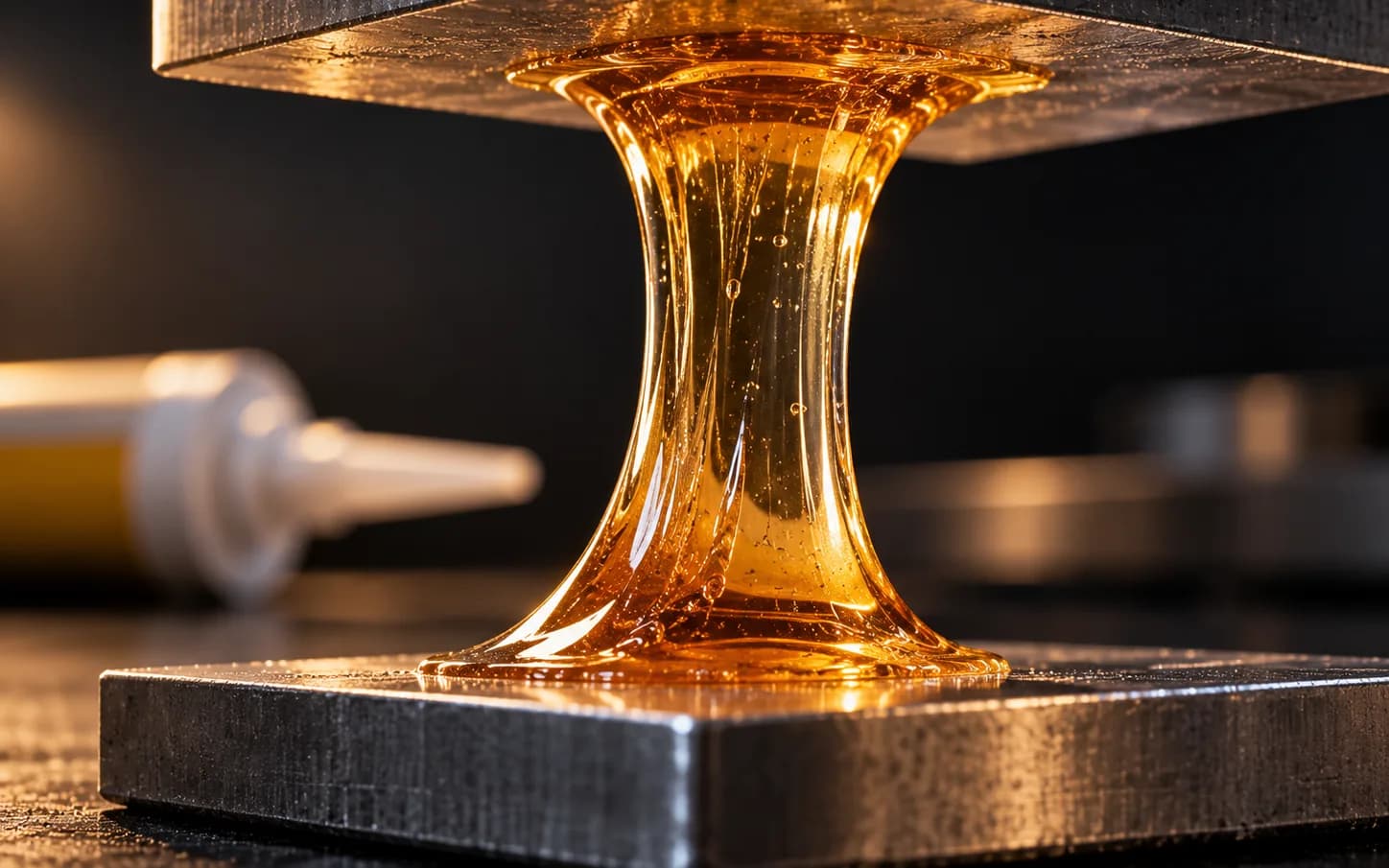
Strong bonds begin long before the joint closes.
Industry 05 / 16
Adhesives & Sealants
Polymer binders, tackifier resins, curing agents and catalysts, silanes, fumed silica, fillers and solvents for makers of water-based, solvent-based and hot-melt adhesives, polyurethane and silicone sealants, wood glues and tapes across India.
An adhesive must wet the surface, build strength at the right speed and hold for years under heat, damp and load. The polymer, the tackifier, the cure chemistry, the filler and the carrier each shape that result. We supply adhesive and sealant chemicals for all five, confirmed against your formulation before quoting, with the manufacturer's COA and SDS on every batch.
- Products for this industry
- 62
- Product groups
- 22
- From categories
- 10
- With every batch
- COA & SDS
What makes an adhesive or sealant work
Water-based glues, hot melts, contact cements and moisture-curing sealants differ in chemistry but share five parts. Each has a clear job, and each is a raw material we supply.
Polymer base
Builds cohesion and the strength of the bond
The polymer sets the character of the bond. Acrylic and styrene-acrylic dispersions carry water-based construction and pressure-sensitive adhesives, polyurethane dispersions suit laminating and flexible bonding, and butyl acrylate is the soft monomer behind many acrylic adhesives. Melamine and resorcinol build formaldehyde resins for laminates and weatherproof wood glues.
- 01
Polymer base
Builds cohesion and the strength of the bond
The polymer sets the character of the bond. Acrylic and styrene-acrylic dispersions carry water-based construction and pressure-sensitive adhesives, polyurethane dispersions suit laminating and flexible bonding, and butyl acrylate is the soft monomer behind many acrylic adhesives. Melamine and resorcinol build formaldehyde resins for laminates and weatherproof wood glues.
- 02
Tackifiers
Add grab and peel strength on contact
Tackifier resins give quick grab and peel strength by helping the polymer wet a surface fast. Gum rosin is the base for rosin esters, C9 hydrocarbon resins suit hot melts and solvent rubber adhesives, waxes set viscosity and open time in hot melts, and antioxidants protect them in the melt tank.
- 03
Cure & adhesion
Cross-link the adhesive and anchor it to the surface
Two-part epoxies cure with amine hardeners, and moisture-curing polyurethane and silicone sealants use tin catalysts to set cure speed. Oxazolidine and aldimine latent hardeners let PU sealants cure without bubbles, while epoxy and organofunctional silanes act as adhesion promoters and crosslinkers on glass, metal and concrete.
- 04
Fillers & rheology
Give body, stop slump and keep fillers suspended
Fumed silica gives sealants thixotropy, so a bead holds its shape on a vertical joint yet extrudes easily. Calcium carbonate and blanc fixe add body and reduce polymer per cartridge, HEC and sodium CMC thicken water-based glues, and magnesium oxide acts as an acid acceptor and curative in polychloroprene contact adhesives.
- 05
Carrier & additives
Carry the polymer, then keep the pack stable
Solvent-based contact and rubber adhesives rely on toluene, acetone, ethyl acetate and cyclohexanone for solvency and the right flash-off speed. Water-based adhesives need defoamers to keep application lines and films free of bubbles, and in-can preservatives such as CMIT/MIT to stop spoilage in drums and pails.
What a adhesives & sealants plant buys from us
Scroll through our product groups for this industry. The number on each tile is how many products we list in it.
- Products
- 62
- Groups
- 22
- Cardanol
- Petroleum Resin GA115B
- Petroleum Resin — other grades
- Gum Rosin
- 11RcResins, Binders & Curing Agents
- 10AdAdditives, Dispersants & Rheology
- 8StSolvents & Thinners
- 5CcConstruction Chemicals & Polymers
- 4AhAdhesives
- 3PfPharma, Food & Specialty Chemicals
- 3CiChemical Intermediates
- Paints, Coatings & Resins
- Solvents & Thinners
- Construction Chemicals, Adhesives & Paper
- Pharma, Food & Specialty Chemicals
- Specialty Inorganics & Chemical Intermediates
Products buyers ask us for most
01What does a tackifier resin do in a hot-melt or pressure-sensitive adhesive?
It gives the adhesive quick grab and peel strength. Base polymers such as EVA, SIS and SBS are strong but not very sticky on their own; a compatible tackifier resin lets the blend flow onto a surface in a fraction of a second and resist peeling. C5 aliphatic, C9 aromatic and blended hydrocarbon resins and rosin esters are the main families. Compatibility with the base polymer decides the choice, so trial blends before switching.
02How do oxazolidines and aldimines prevent bubbles in polyurethane sealants?
They change how moisture cures the sealant. In a standard one-part polyurethane, water reacts with isocyanate and releases carbon dioxide, which can form bubbles in thick beads and high-build coats. Oxazolidines and aldimines react with moisture first and release an amine, plus a hydroxyl group from oxazolidines, that then reacts with the isocyanate without producing gas. Mono-oxazolidines are also used as moisture scavengers to dry polyols, fillers and pigments.
03What is the difference between a structural adhesive and a contact adhesive?
A structural adhesive forms a load-bearing joint, often above 10 MPa in lap shear, using epoxy, polyurethane, acrylic or phenolic chemistry that cures after the parts are joined. A contact adhesive is a solvent- or water-based elastomer, often polychloroprene or nitrile rubber, coated on both surfaces, left until touch-dry, then pressed together for instant grab. Contact adhesives suit laminates, foam, leather and rubber; structural adhesives can replace rivets, screws and welds.
04Why do water-based adhesives need a preservative?
Because water, polymer dispersions, cellulose thickeners and starch feed bacteria and fungi. Without an in-can preservative, a drum of PVA or acrylic adhesive can lose viscosity, smell, build gas or grow mould before it is used. Isothiazolinones such as CMIT/MIT and BIT are common in-can choices, dosed as the supplier's TDS directs and within local regulatory limits. Clean tanks, pipes and filling lines matter as much as the preservative itself.
One partner for 16 industries
- 01Paints & CoatingsPigments, binders, driers, additives
- 02Printing InksPigments, resins, solvents
- 03Plastics, Polymers & RubberStabilisers, modifiers, waxes
- 04ConstructionPolymers, silanes, admixture salts
- 06Paper & BoardBinders, wet-end chemicals
- 07Water & WastewaterProgrammes, coagulants, biocides
- 08Oil & GasScavengers, brines, drilling aids
- 09PharmaceuticalsExcipients, intermediates, solvents
- 10Food & NutritionAcids, preservatives, minerals
- 11Personal CareEmulsifiers, actives, preservatives
- 12Home Care & DetergentsSurfactants, builders, actives
- 13Agriculture & FertilisersPhosphates, nitrates, chelates
- 14Glass, Ceramics & MetallurgyBorates, fluorides, ferro alloys
- 15Leather & TextilesChromium salts, oxidants, auxiliaries
- 16Lithium & Advanced MaterialsLithium & tungsten compounds


Tell us what your next batch needs.
Product, grade or make, quantity and delivery location are enough. We confirm the specification before we quote, and every batch ships with the manufacturer's COA and SDS.