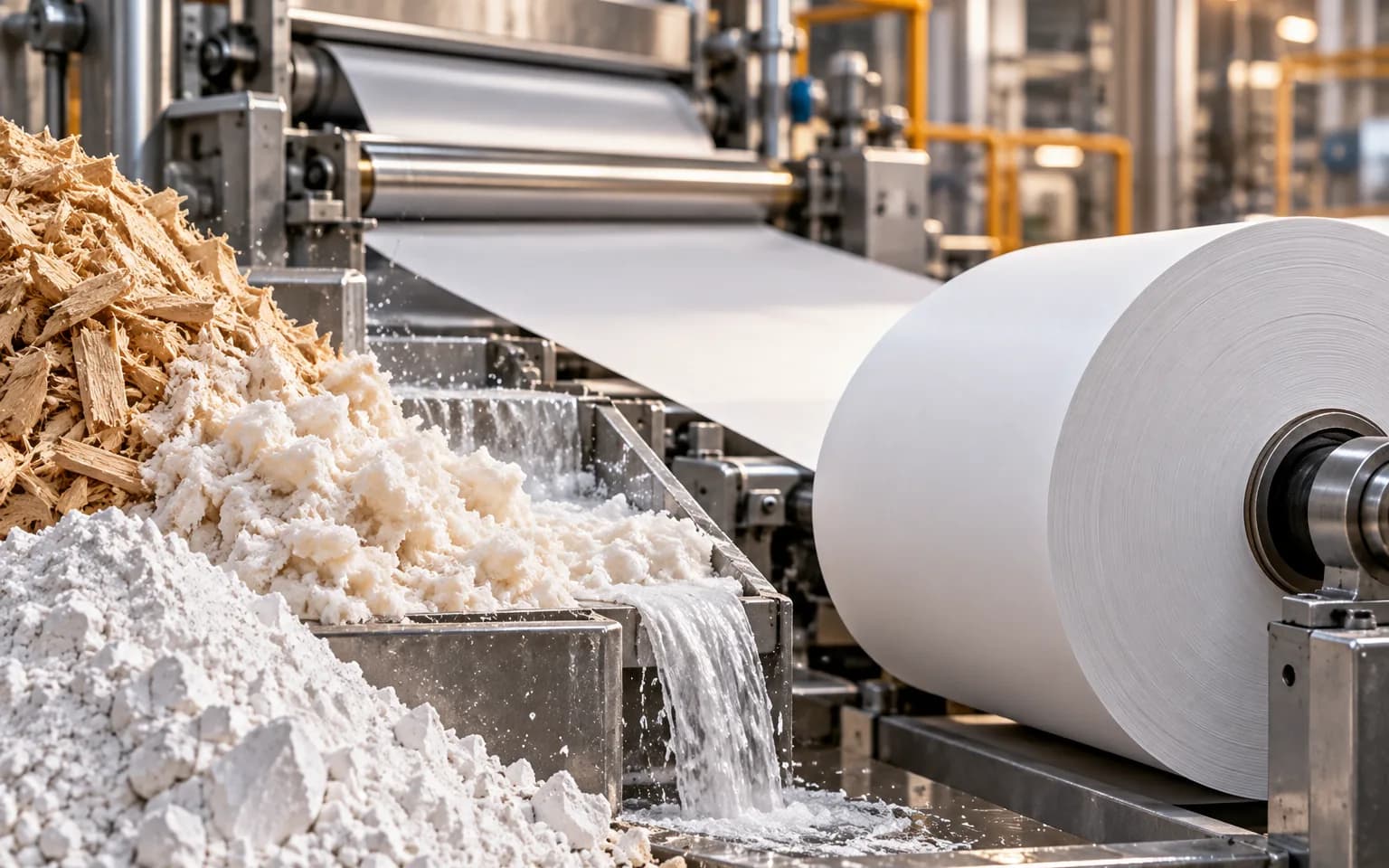
Sheet quality is decided long before the reel.
Industry 06 / 16
Paper & Board
Wet-end and sizing chemicals, coating binders and pigments, pulp bleaching chemicals and mill water treatments for makers of writing and printing paper, kraft, duplex and packaging board, tissue and specialty grades across India.
Paper is mostly fibre and water, but the chemistry added along the way decides brightness, strength, ink hold-out and how cleanly the machine runs. Change a size, a binder or a bleach stabiliser and the sheet changes with it. We supply pulp, wet-end, coating and utility chemicals matched to your grade, furnish and pH, from established producers.
- Products for this industry
- 55
- Product groups
- 27
- From categories
- 9
- With every batch
- COA & SDS
What goes into a sheet of paper
From pulp to coated board, papermaking runs through five chemical steps. Each has its own raw materials, and each is something we can source to your mill's specification.
Pulping & bleaching
Cooks, cleans and brightens the fibre
Kraft cooking runs on caustic soda and sodium sulphide, with salt cake topping up sodium and sulphur in recovery. Bleaching then lifts brightness: hydrogen peroxide for mechanical and recycled pulp, protected by chelants that lock up manganese and iron, and sodium borohydride, which generates hydrosulphite for reductive brightening.
- 01
Pulping & bleaching
Cooks, cleans and brightens the fibre
Kraft cooking runs on caustic soda and sodium sulphide, with salt cake topping up sodium and sulphur in recovery. Bleaching then lifts brightness: hydrogen peroxide for mechanical and recycled pulp, protected by chelants that lock up manganese and iron, and sodium borohydride, which generates hydrosulphite for reductive brightening.
- 02
Wet end
Retains fines and filler, sizes and strengthens
Before the headbox the stock needs retention and drainage aids, strength additives and sizing. Rosin size fortified with fumaric acid is set with alum in acid systems, while neutral and alkaline machines use reactive sizes. PAC fixes anionic trash and defoamers keep entrained air out of the sheet.
- 03
Fillers & colour
Opacity, brightness and the final shade
Calcium carbonate fills and brightens alkaline sheets, and titanium dioxide adds opacity to thin and white-top grades, with anatase often chosen for its lower abrasion on wires. Small doses of blue pigment correct yellowness, while iron oxides and effect pigments colour decor and specialty papers.
- 04
Coating
Builds a smooth, printable surface
A coating colour is mostly pigment held together by latex. Styrene-butadiene and styrene-acrylic binders anchor particles to each other and the base sheet, CMC controls water retention and flow, and dispersants keep high-solids slurries fluid. Surface sizing and barrier dispersions add print quality and water or grease resistance.
- 05
Steam & water
Keeps boilers, water loops and effluent in control
Paper mills raise large volumes of steam and recycle white water. Boiler treatments prevent scale and condensate corrosion, non-oxidising biocides and bio-dispersants control slime in machine loops and cooling circuits, and coagulants with anionic polyelectrolyte clarify effluent before discharge or reuse.
What a paper & board plant buys from us
Scroll through our product groups for this industry. The number on each tile is how many products we list in it.
- Products
- 55
- Groups
- 27
- Sludge Conditioner
- Alkaline Phosphate Blend — Big Boilers
- Phosphonate Sludge Conditioner
- Filming Amine Treatment
- 6BwBoiler Water Treatment
- 4CtCooling Tower Treatment
- 4ObOxidants, Bleaches & Disinfectants
- 3WfWhite & Functional Pigments
- 3AdAdditives, Dispersants & Rheology
- 3PcPaper Chemicals
- 3CgCoagulants & Flocculants
- 3ApAmmonium, Potassium & Sodium Salts
- 3CiChemical Intermediates
- Water Treatment Programme Chemicals
- Industrial Process & Water Treatment
- Pigments & Colourants
- Paints, Coatings & Resins
- Construction Chemicals, Adhesives & Paper
- Inorganic Salts & Metal Compounds
- Specialty Inorganics & Chemical Intermediates
Products buyers ask us for most
01What is the difference between rosin sizing and AKD or ASA sizing?
Rosin size is the traditional acid-system size: rosin, often fortified with fumaric acid or maleic anhydride, is precipitated onto the fibres with alum, which works best at around pH 4.5 to 5.5. AKD and ASA are reactive sizes that bond with cellulose at neutral to alkaline pH, so they suit machines using calcium carbonate filler. ASA reacts quickly and is emulsified at the mill just before use, while AKD develops full sizing more slowly, often after the sheet leaves the machine.
02GCC or PCC: which calcium carbonate suits paper filling and coating?
Both are calcium carbonate, made in different ways. Ground calcium carbonate (GCC) is milled limestone, marble or chalk and is widely used in coating colours and as filler. Precipitated calcium carbonate (PCC) is made by reacting slaked lime with carbon dioxide, so its particle size and crystal shape can be controlled; scalenohedral PCC fillers add bulk and opacity. Either needs a neutral or alkaline wet end, because carbonate dissolves in acid alum systems.
03Why is pulp treated with a chelant before hydrogen peroxide bleaching?
Manganese, iron and copper carried in with the wood and process water catalyse the breakdown of hydrogen peroxide into oxygen and water, wasting the charge and limiting brightness. A chelation (Q) stage with EDTA or DTPA, usually at mildly acidic to neutral pH, binds these metals so they wash out before bleaching. Mechanical pulps are also bleached with sodium silicate and magnesium sulphate in the peroxide liquor to stabilise it further.
04Styrene-butadiene or styrene-acrylic latex: which binder suits a paper coating?
Carboxylated styrene-butadiene (SB) latex is the most widely used coating binder for paper and board, giving strong pigment binding, good print gloss and flexible films. Its butadiene content makes it prone to yellowing with light and age. Styrene-acrylic latex resists yellowing and is often chosen for speciality papers and boards and brightness-sensitive grades. The right binder and dosage depend on the pigment, the printing method and the coating strength needed.
One partner for 16 industries
- 01Paints & CoatingsPigments, binders, driers, additives
- 02Printing InksPigments, resins, solvents
- 03Plastics, Polymers & RubberStabilisers, modifiers, waxes
- 04ConstructionPolymers, silanes, admixture salts
- 05Adhesives & SealantsBinders, silanes, tackifiers
- 07Water & WastewaterProgrammes, coagulants, biocides
- 08Oil & GasScavengers, brines, drilling aids
- 09PharmaceuticalsExcipients, intermediates, solvents
- 10Food & NutritionAcids, preservatives, minerals
- 11Personal CareEmulsifiers, actives, preservatives
- 12Home Care & DetergentsSurfactants, builders, actives
- 13Agriculture & FertilisersPhosphates, nitrates, chelates
- 14Glass, Ceramics & MetallurgyBorates, fluorides, ferro alloys
- 15Leather & TextilesChromium salts, oxidants, auxiliaries
- 16Lithium & Advanced MaterialsLithium & tungsten compounds






Tell us what your next batch needs.
Product, grade or make, quantity and delivery location are enough. We confirm the specification before we quote, and every batch ships with the manufacturer's COA and SDS.