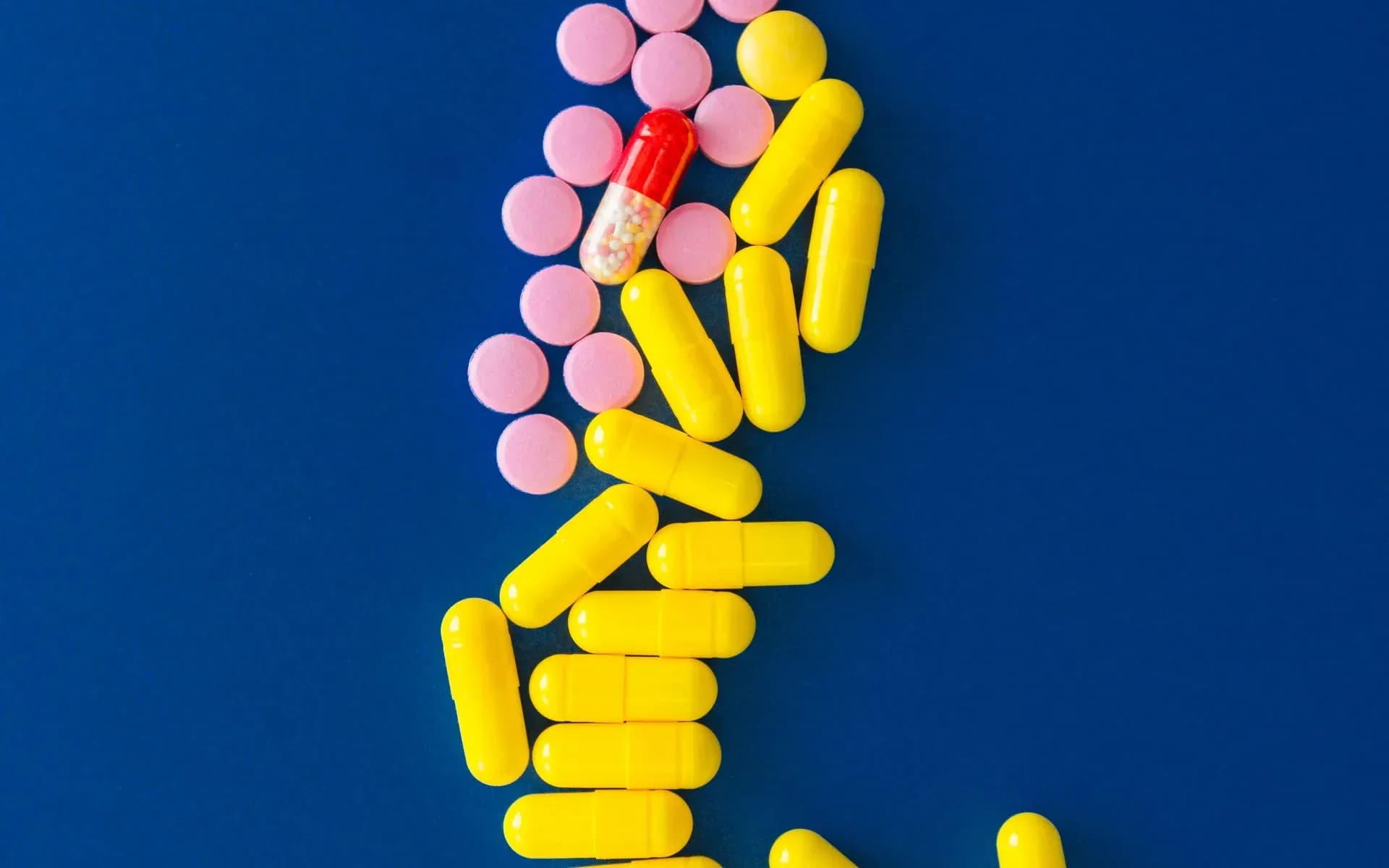
Every batch record begins with its raw materials.
Industry 09 / 16
Pharmaceuticals
Excipients, API intermediates, synthesis reagents, process solvents, buffer salts and vitamin and mineral ingredients for formulation plants, bulk drug units and nutraceutical manufacturers across India, with grade and documents confirmed for each requirement.
In pharmaceutical manufacturing a raw material becomes part of the batch record. Its grade, impurity profile and paperwork have to match what your specification says, every single time. We supply pharma raw materials, excipients, intermediates and solvents from established Indian and global producers, confirm grade and make before quoting, and send the manufacturer's COA and SDS with every batch.
- Products for this industry
- 168
- Product groups
- 31
- From categories
- 12
- With every batch
- COA & SDS
From synthesis to dosage form in five parts
A finished medicine draws on five families of raw material, from the reagents that build the molecule to the excipients that turn it into a dose. We source each to your specification.
Synthesis
Builds the API from intermediates and reagents
API plants build a molecule step by step. Brominating agents such as NBS, reducing agents such as sodium borohydride and acid catalysts such as PTSA drive individual reactions, while intermediates lead to the final active: CMH is resolved to RCMH, which a Hofmann rearrangement converts to pregabalin.
- 01
Synthesis
Builds the API from intermediates and reagents
API plants build a molecule step by step. Brominating agents such as NBS, reducing agents such as sodium borohydride and acid catalysts such as PTSA drive individual reactions, while intermediates lead to the final active: CMH is resolved to RCMH, which a Hofmann rearrangement converts to pregabalin.
- 02
Solvents
Carry reactions, extraction and crystallisation
Solvents dissolve reactants, extract products and crystallise the pure API, then must be removed to within ICH Q3C residual limits. Acetone, IPA and ethyl acetate are low-toxicity Class 3 solvents; methylene chloride, toluene and pyridine are Class 2, with tighter individual limits.
- 03
Excipients
Turn an active into a tablet or capsule
Fillers such as dicalcium and tricalcium phosphate give a tablet its bulk, povidone binds granules, magnesium stearate stops the blend sticking to punches and dies, and silicon dioxide helps powders flow. Each is chosen for particle size, moisture and how it compresses.
- 04
Liquids & creams
Vehicles for syrups, ointments and soft-gels
Oral liquids, ointments, creams and soft-gel fills rely on co-solvents, humectants, emulsifiers and preservatives. PEG 400, propylene glycol and glycerine dissolve and carry actives, polysorbates and cetostearyl alcohol build stable emulsions, and parabens protect water-containing products from microbial spoilage.
- 05
Buffers & salts
Set pH, effervescence and mineral content
Citrates, tartaric acid and bicarbonates buffer syrups and generate the fizz in effervescent tablets, which react as soon as water arrives and so need dry handling. Mineral salts and vitamins such as calcium gluconate and ascorbic acid go into nutraceutical and fortified formulations.
What a pharmaceuticals plant buys from us
Scroll through our product groups for this industry. The number on each tile is how many products we list in it.
- Products
- 168
- Groups
- 31
- PVP K30
- PVP K90
- Benzoyl Peroxide IP — Micronised
- Citric Acid Monohydrate
- PfPharma, Food & Specialty Chemicals
- CiChemical Intermediates
- EeEmulsifiers, Esters & Thickeners
- StSolvents & Thinners
- CcChromium, Copper, Cobalt, Nickel, Manganese & Zinc Compounds
- SpSpecialty Inorganics
- CgCalcium, Magnesium & Aluminium Compounds
- RpRO Plant Chemicals
- ObOxidants, Bleaches & Disinfectants
- PhPhosphates
- FaFatty Acids, Glycerine & Oleochemicals
- OiOil & Gas / Oilfield
- 25PfPharma, Food & Specialty Chemicals
- 19CiChemical Intermediates
- 10EeEmulsifiers, Esters & Thickeners
- 8StSolvents & Thinners
- 8CcChromium, Copper, Cobalt, Nickel, Manganese & Zinc Compounds
- 8SpSpecialty Inorganics
- 7CgCalcium, Magnesium & Aluminium Compounds
- 6RpRO Plant Chemicals
- 6ObOxidants, Bleaches & Disinfectants
- 6PhPhosphates
- 5FaFatty Acids, Glycerine & Oleochemicals
- 5OiOil & Gas / Oilfield
- Pharma, Food & Specialty Chemicals
- Specialty Inorganics & Chemical Intermediates
- Personal Care & Cosmetic Ingredients
- Solvents & Thinners
- Inorganic Salts & Metal Compounds
- Water Treatment Programme Chemicals
- Industrial Process & Water Treatment
- Oleochemicals, Terpenes & Specialty Oils
- Oil & Gas / Oilfield
Products buyers ask us for most
01Which common solvents are ICH Q3C Class 2 and which are Class 3?
Under ICH Q3C, Class 2 solvents carry individual limits in the drug product: methylene chloride 600 ppm, toluene 890 ppm, pyridine 200 ppm and chloroform 60 ppm. Class 3 solvents such as acetone, ethyl acetate and isopropyl alcohol have low toxic potential and are acceptable up to 5,000 ppm (0.5%) without further justification. Class 1 solvents such as benzene should be avoided. Choosing a Class 3 solvent where the chemistry allows makes residual solvent control simpler.
02How much magnesium stearate should a tablet blend contain?
The Handbook of Pharmaceutical Excipients gives 0.25-5.0% w/w as the lubricant range, and most blends sit near the low end, around 0.5-1%, added last and mixed briefly. Too little and the blend sticks to punches and die walls. Too much, or mixing too long, coats particles with a water-repellent film that can soften tablets and slow disintegration and dissolution. Fix the level and blending time during development and hold them constant.
03What is the difference between pharmacopoeial and technical grade chemicals?
A pharmacopoeial grade (IP, BP, USP or Ph. Eur.) is made and tested to a monograph that fixes identity, assay, impurities and limits such as heavy metals or residual solvents, and is meant for use in medicines. A technical grade is specified only for industrial performance. The same chemical name can be sold in both, so state the grade on every enquiry. We confirm the grade and documents the producer can offer against your requirement before quoting.
04What documents should come with a pharmaceutical raw material?
Every batch should arrive with the manufacturer's certificate of analysis (COA), showing the batch number and results against the agreed specification, and a safety data sheet (SDS). For vendor qualification, QA teams usually also want a specification or TDS and samples to test at their own site. Lithionyx sends the manufacturer's COA and SDS with every batch, provides samples and TDS on request, and labels every pack with product, batch and hazard details for traceability.
One partner for 16 industries
- 01Paints & CoatingsPigments, binders, driers, additives
- 02Printing InksPigments, resins, solvents
- 03Plastics, Polymers & RubberStabilisers, modifiers, waxes
- 04ConstructionPolymers, silanes, admixture salts
- 05Adhesives & SealantsBinders, silanes, tackifiers
- 06Paper & BoardBinders, wet-end chemicals
- 07Water & WastewaterProgrammes, coagulants, biocides
- 08Oil & GasScavengers, brines, drilling aids
- 10Food & NutritionAcids, preservatives, minerals
- 11Personal CareEmulsifiers, actives, preservatives
- 12Home Care & DetergentsSurfactants, builders, actives
- 13Agriculture & FertilisersPhosphates, nitrates, chelates
- 14Glass, Ceramics & MetallurgyBorates, fluorides, ferro alloys
- 15Leather & TextilesChromium salts, oxidants, auxiliaries
- 16Lithium & Advanced MaterialsLithium & tungsten compounds





Tell us what your next batch needs.
Product, grade or make, quantity and delivery location are enough. We confirm the specification before we quote, and every batch ships with the manufacturer's COA and SDS.