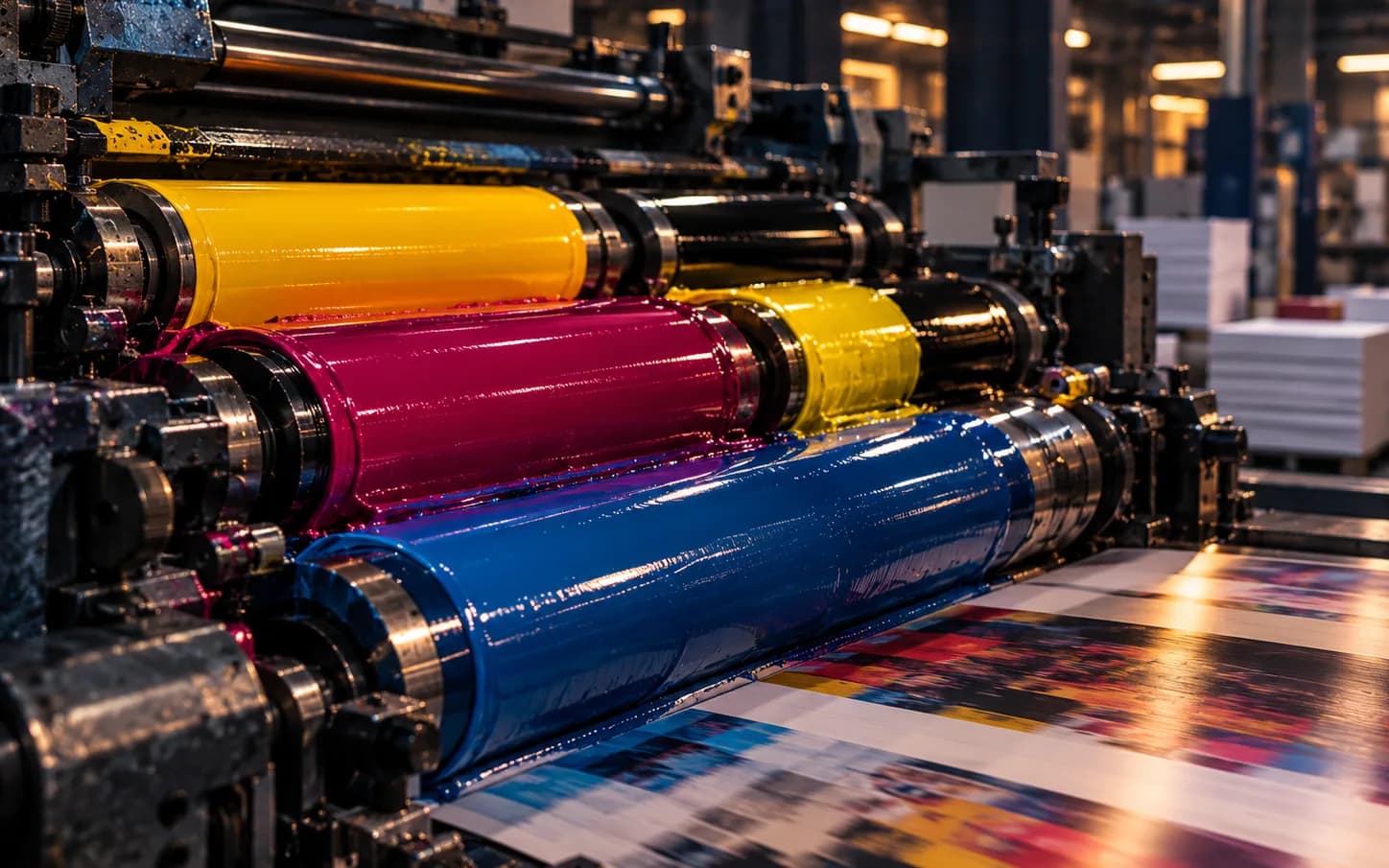
Sharp print, steady colour, run after run.
Industry 02 / 16
Printing Inks
Pigments, metallic powders, hard resins, solvents, driers and additives for makers of offset, flexo, gravure and screen printing inks, packaging inks and overprint varnishes across India, matched to your press, substrate and ink system.
An ink has a fraction of a second to transfer, set and stay put. Pigment strength, resin solubility, solvent balance and drier level decide its colour, tack, drying speed and rub resistance on press. We supply the printing ink chemicals behind offset, flexo, gravure and screen inks, grade-matched before quoting, so shade and press behaviour stay steady batch after batch.
- Products for this industry
- 76
- Product groups
- 20
- From categories
- 11
- With every batch
- COA & SDS
What goes into a printing ink
Offset paste inks and liquid flexo and gravure inks use different chemistry, but both are built from the same five parts, and each part is a raw material we supply.
Pigments
Carry the colour, strength and transparency
Process inks rest on a few pigments: beta phthalocyanine blue for cyan, rubine toner for magenta and organic yellows, with Prussian blue to tone blacks. Spot and packaging shades add phthalo green, violet and orange, and rutile titanium dioxide gives the opaque white behind reverse-printed film.
- 01
Pigments
Carry the colour, strength and transparency
Process inks rest on a few pigments: beta phthalocyanine blue for cyan, rubine toner for magenta and organic yellows, with Prussian blue to tone blacks. Spot and packaging shades add phthalo green, violet and orange, and rutile titanium dioxide gives the opaque white behind reverse-printed film.
- 02
Resins
Bind pigment to the substrate and build gloss
Resins form the varnish that carries pigment and locks it to paper, board or film. Gum rosin is the starting point for rosin esters and resinates, C9 hydrocarbon resins add gloss and body, linseed fatty acids build alkyds for oxidative inks, and polyurethane dispersions and PVP form films in water-based inks.
- 03
Solvents
Set viscosity and how fast the ink dries
Flexo and gravure inks dry by evaporation, so the solvent blend decides press speed and retained solvent. Alcohols and esters such as IPA and ethyl acetate lead in packaging. Toluene, excluded from food-packaging inks under IS 15495, stays in industrial work, and cyclohexanone is a strong, slow solvent for vinyl screen inks.
- 04
Metallic effects
Silver, gold and pearl finishes for packs and labels
Fine aluminium pastes print bright silver, while gold bronze powders and pale gold lining give gold on cartons, labels and wrappers, and pearl pigments add soft lustre. Flake size, leafing behaviour and the ink vehicle decide brilliance, so we confirm the grade against your printing process before quoting.
- 05
Additives
Control drying, flow, rub and press behaviour
Cobalt and manganese octoates catalyse the oxidative drying of sheetfed offset inks, and MEK oxime holds back skinning in the tin. Lecithin wets pigment during grinding, polyethylene wax adds rub and scuff resistance, and defoamers keep water-based flexo inks free of foam at speed.
What a printing inks plant buys from us
Scroll through our product groups for this industry. The number on each tile is how many products we list in it.
- Products
- 76
- Groups
- 20
- Pigment Red 112
- Pigment Blue 15:3
- Pigment Green 7
- Pigment Violet 23
- 15OpOrganic Pigments & Pigment Pastes
- 10PcPaint Driers & Catalysts
- 8CbChrome, Blue & Other Inorganic Pigments
- 7AdAdditives, Dispersants & Rheology
- 7StSolvents & Thinners
- 6RcResins, Binders & Curing Agents
- 5MpMetallic Pigments
- 4WfWhite & Functional Pigments
- Pigments & Colourants
- Paints, Coatings & Resins
- Solvents & Thinners
Products buyers ask us for most
01Which pigments are used in CMYK process printing inks?
Process cyan is almost always Pigment Blue 15:3, the beta form of copper phthalocyanine blue, and process magenta is usually Pigment Red 57:1, sold as rubine toner. Process yellow is typically a diarylide yellow such as Pigment Yellow 12 or 13, and black is carbon black, often toned with a blue such as Prussian blue for a deeper, more neutral black. The ink system and substrate decide the exact grade.
02Which solvents are used in flexo and gravure packaging inks?
Mainly alcohols and esters. Ethanol, isopropanol and n-propanol dissolve the binder and evaporate quickly, while ethyl acetate and n-propyl acetate are used with nitrocellulose and polyurethane resins, especially in gravure. Small amounts of slower solvents stop ink drying on the anilox roll or cylinder. In India, food-packaging inks must follow IS 15495, which the FSSAI packaging regulations refer to and which excludes toluene, so food-pack converters ask for toluene-free inks.
03How do sheetfed offset inks dry, and why are cobalt and manganese driers added?
Sheetfed offset inks dry in two steps: the thin oil fraction sets into the paper by absorption, then the drying oils and alkyds in the vehicle cross-link with oxygen from the air. Cobalt octoate is a strong surface drier and manganese octoate is also active, and the two are often used together at low doses. Too much drier shortens shelf life and can dry ink on the rollers, so the dose comes from the ink maker's trials.
04What do waxes do in printing inks?
Waxes give printed work rub, scuff and scratch resistance and add slip. Fine micronised polyethylene wax moves to the surface as the ink film forms and leaves a low-friction layer, so cartons, labels and magazines survive stacking, transport and handling without marking. Polyethylene gives hardness and rub resistance, and PTFE blends add extra slip. Choose the grade by particle size, melting point and ink type: offset, flexo or gravure, water- or solvent-based.
One partner for 16 industries
- 01Paints & CoatingsPigments, binders, driers, additives
- 03Plastics, Polymers & RubberStabilisers, modifiers, waxes
- 04ConstructionPolymers, silanes, admixture salts
- 05Adhesives & SealantsBinders, silanes, tackifiers
- 06Paper & BoardBinders, wet-end chemicals
- 07Water & WastewaterProgrammes, coagulants, biocides
- 08Oil & GasScavengers, brines, drilling aids
- 09PharmaceuticalsExcipients, intermediates, solvents
- 10Food & NutritionAcids, preservatives, minerals
- 11Personal CareEmulsifiers, actives, preservatives
- 12Home Care & DetergentsSurfactants, builders, actives
- 13Agriculture & FertilisersPhosphates, nitrates, chelates
- 14Glass, Ceramics & MetallurgyBorates, fluorides, ferro alloys
- 15Leather & TextilesChromium salts, oxidants, auxiliaries
- 16Lithium & Advanced MaterialsLithium & tungsten compounds








Tell us what your next batch needs.
Product, grade or make, quantity and delivery location are enough. We confirm the specification before we quote, and every batch ships with the manufacturer's COA and SDS.