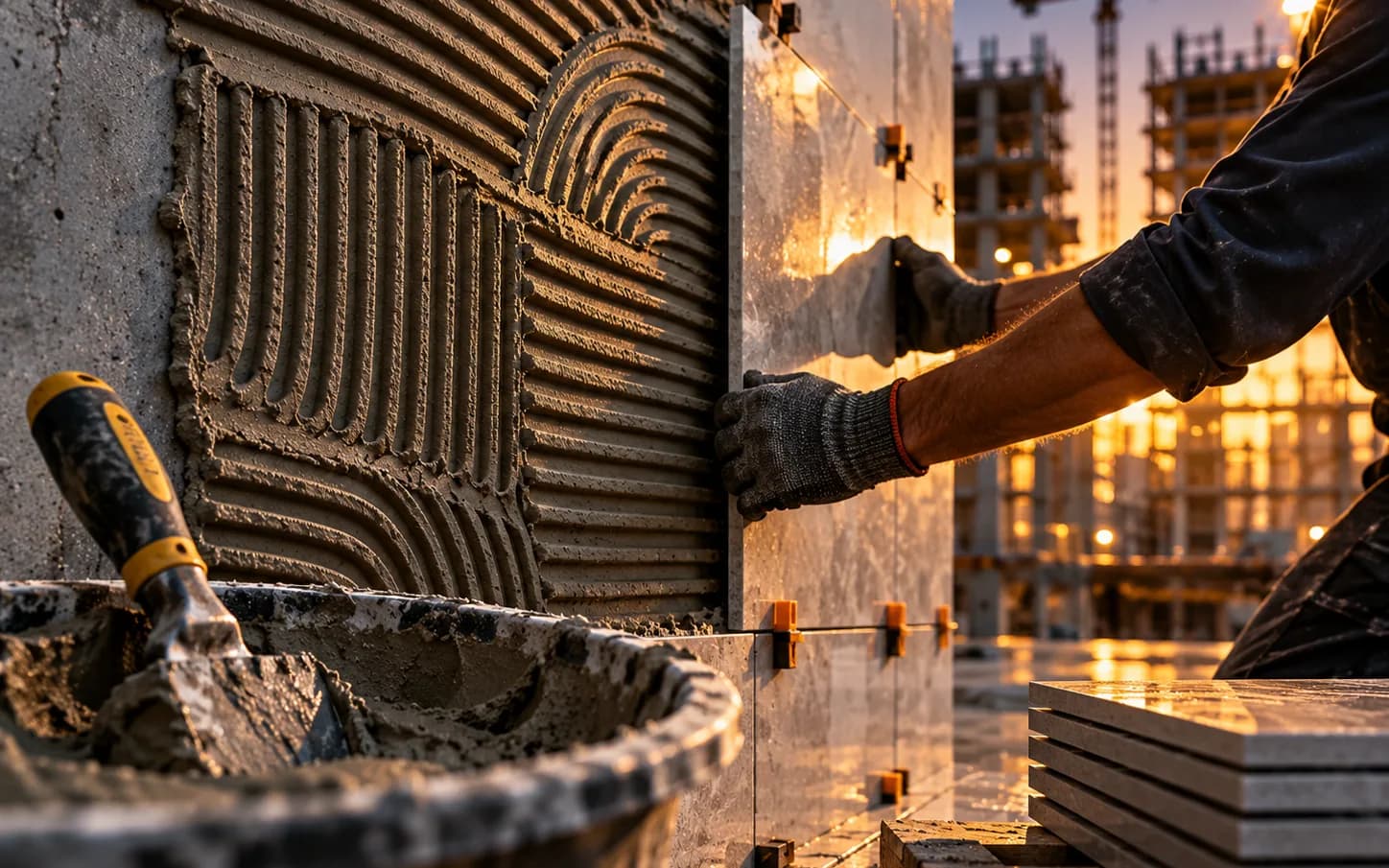
What holds a building together is chemistry.
Industry 04 / 16
Construction
Polymer binders, redispersible powders, cellulose ethers, admixture salts, iron oxide pigments, fillers and epoxy curing agents for makers of tile adhesives, wall putty, waterproofing, concrete admixtures, pavers, floorings and building paints across India.
Cement, sand and water do the heavy lifting, but small additions decide how a mix sets, sticks, flows and weathers. A fraction of a per cent of polymer, cellulose ether or admixture salt can decide whether a tile stays put or a slab cracks. We supply these construction chemicals and raw materials, grade-matched before quoting, with the manufacturer's COA on every batch.
- Products for this industry
- 128
- Product groups
- 32
- From categories
- 12
- With every batch
- COA & SDS
What goes into mortar, concrete and putty
Tile adhesives, putties, admixtures and floor systems differ in recipe but share five building blocks. Each does one clear job, and each is a raw material we supply.
Polymers
Add adhesion, flexibility and water resistance
Polymers turn brittle cement into a flexible, adhesive layer. Redispersible powder goes into dry-mix tile adhesives, putty and repair mortars; liquid Styrofan and Acronal binders go into waterproofing membranes and primers; acrylic emulsions and polyurethane dispersions bind exterior paints, roof coatings and waterproof finishes.
- 01
Polymers
Add adhesion, flexibility and water resistance
Polymers turn brittle cement into a flexible, adhesive layer. Redispersible powder goes into dry-mix tile adhesives, putty and repair mortars; liquid Styrofan and Acronal binders go into waterproofing membranes and primers; acrylic emulsions and polyurethane dispersions bind exterior paints, roof coatings and waterproof finishes.
- 02
Water retention
Hold water so cement cures and stays workable
Cellulose ethers keep water in a thin mortar bed long enough for the cement to hydrate, extend open time and help stop tiles slipping. MHEC is standard in tile adhesives and putty, HEC thickens plasters and textured coatings, sodium CMC binds distemper and pastes, and calcium stearate adds water repellency.
- 03
Admixtures
Control setting time, water demand and strength
Calcium nitrate speeds setting and early strength without adding chloride, and calcium chloride suits plain concrete only. Sodium gluconate and tartaric acid delay setting for ready-mix transport, hot weather and gypsum plasters. Sodium lignosulphonate cuts water demand as a plasticiser, and ferrous sulphate reduces hexavalent chromium in cement.
- 04
Colour & fillers
Colour pavers and tiles, add body to putty
Synthetic iron oxides give red, yellow, brown and black paver blocks, roof tiles and coloured concrete, and chromium oxide gives a durable green. Calcite and whiting fill wall putty, distemper and textures, while hydrated lime improves workability and water retention in mortars and plasters.
- 05
Floors & protection
Cure epoxy floors and protect concrete and steel
Amidoamine and cycloaliphatic hardeners cure epoxy primers, self-levelling floors and grouts, and waterborne curing agents give low-odour floor paints. Aldimine hardeners help polyurethane floors and sealants cure without bubbles, silanes promote adhesion in sealants, and ammonium polyphosphate drives intumescent fire-protective coatings for structural steel.
What a construction plant buys from us
Scroll through our product groups for this industry. The number on each tile is how many products we list in it.
- Products
- 128
- Groups
- 32
- Styrene Acrylic — Warm Base
- Neobind 7050 SC
- Sensocryl AS 60 Liquid
- Epoxy Hardener 9140
- RcResins, Binders & Curing Agents
- OpOrganic Pigments & Pigment Pastes
- AdAdditives, Dispersants & Rheology
- MpModifiers, Processing Aids & Resins
- IoIron Oxide Pigments
- WfWhite & Functional Pigments
- FiFillers, Extenders & Grinding Media
- CcCalcium, Magnesium & Aluminium Compounds
- OiOil & Gas / Oilfield
- ChChromium, Copper, Cobalt, Nickel, Manganese & Zinc Compounds
- SpSpecialty Inorganics
- CpConstruction Chemicals & Polymers
- 16RcResins, Binders & Curing Agents
- 10OpOrganic Pigments & Pigment Pastes
- 10AdAdditives, Dispersants & Rheology
- 8MpModifiers, Processing Aids & Resins
- 7IoIron Oxide Pigments
- 6WfWhite & Functional Pigments
- 6FiFillers, Extenders & Grinding Media
- 6CcCalcium, Magnesium & Aluminium Compounds
- 5OiOil & Gas / Oilfield
- 5ChChromium, Copper, Cobalt, Nickel, Manganese & Zinc Compounds
- 5SpSpecialty Inorganics
- 4CpConstruction Chemicals & Polymers
- Paints, Coatings & Resins
- Pigments & Colourants
- Plastics & Rubber Additives
- Inorganic Salts & Metal Compounds
- Oil & Gas / Oilfield
- Specialty Inorganics & Chemical Intermediates
- Construction Chemicals, Adhesives & Paper
Products buyers ask us for most
01Calcium chloride or calcium nitrate: which accelerator suits reinforced concrete?
Calcium nitrate, or another non-chloride accelerator. Calcium chloride speeds setting well, but the chloride it adds raises the risk of steel corrosion, so ACI guidance says it should not be used in steel-reinforced concrete, and IS 456 limits the total chloride in reinforced and prestressed mixes. Keep calcium chloride for plain concrete with no embedded steel. Calcium nitrate speeds setting and early strength without adding chloride.
02What is the difference between a plasticiser and a superplasticiser in concrete?
The amount of mixing water they remove. A plasticiser, or normal water reducer, such as one based on sodium lignosulphonate, cuts water by at least 5% at the same workability (ASTM C494 Type A). A superplasticiser, or high-range water reducer, usually based on sulphonated naphthalene formaldehyde or polycarboxylate ether, cuts it by 12% or more (Type F), giving flowing or high-strength concrete. Lignosulphonates can also retard setting at higher doses.
03When is a set retarder such as sodium gluconate used?
When concrete or mortar must stay workable for longer: ready-mix travelling long distances, hot-weather pours, large or continuous placements that must avoid cold joints, and long pumping runs. Sodium gluconate retards cement at very low doses and also reduces water slightly, while tartaric and citric acids are common retarders for gypsum plasters. Set the dose by trial mixes at site temperature, because an overdose can hold the set far longer than planned.
04How much iron oxide pigment is used to colour paver blocks and concrete?
Usually 1% to 5% of the cement or binder weight. Synthetic iron oxides reach their saturation point at about 5%, so higher doses add little colour, cost more and can lower strength. Always dose by cement weight, not total mix weight, and keep the cement, water content and curing consistent, because they change the final shade as much as the pigment does. White cement gives brighter, cleaner colours than grey cement.
One partner for 16 industries
- 01Paints & CoatingsPigments, binders, driers, additives
- 02Printing InksPigments, resins, solvents
- 03Plastics, Polymers & RubberStabilisers, modifiers, waxes
- 05Adhesives & SealantsBinders, silanes, tackifiers
- 06Paper & BoardBinders, wet-end chemicals
- 07Water & WastewaterProgrammes, coagulants, biocides
- 08Oil & GasScavengers, brines, drilling aids
- 09PharmaceuticalsExcipients, intermediates, solvents
- 10Food & NutritionAcids, preservatives, minerals
- 11Personal CareEmulsifiers, actives, preservatives
- 12Home Care & DetergentsSurfactants, builders, actives
- 13Agriculture & FertilisersPhosphates, nitrates, chelates
- 14Glass, Ceramics & MetallurgyBorates, fluorides, ferro alloys
- 15Leather & TextilesChromium salts, oxidants, auxiliaries
- 16Lithium & Advanced MaterialsLithium & tungsten compounds











Tell us what your next batch needs.
Product, grade or make, quantity and delivery location are enough. We confirm the specification before we quote, and every batch ships with the manufacturer's COA and SDS.