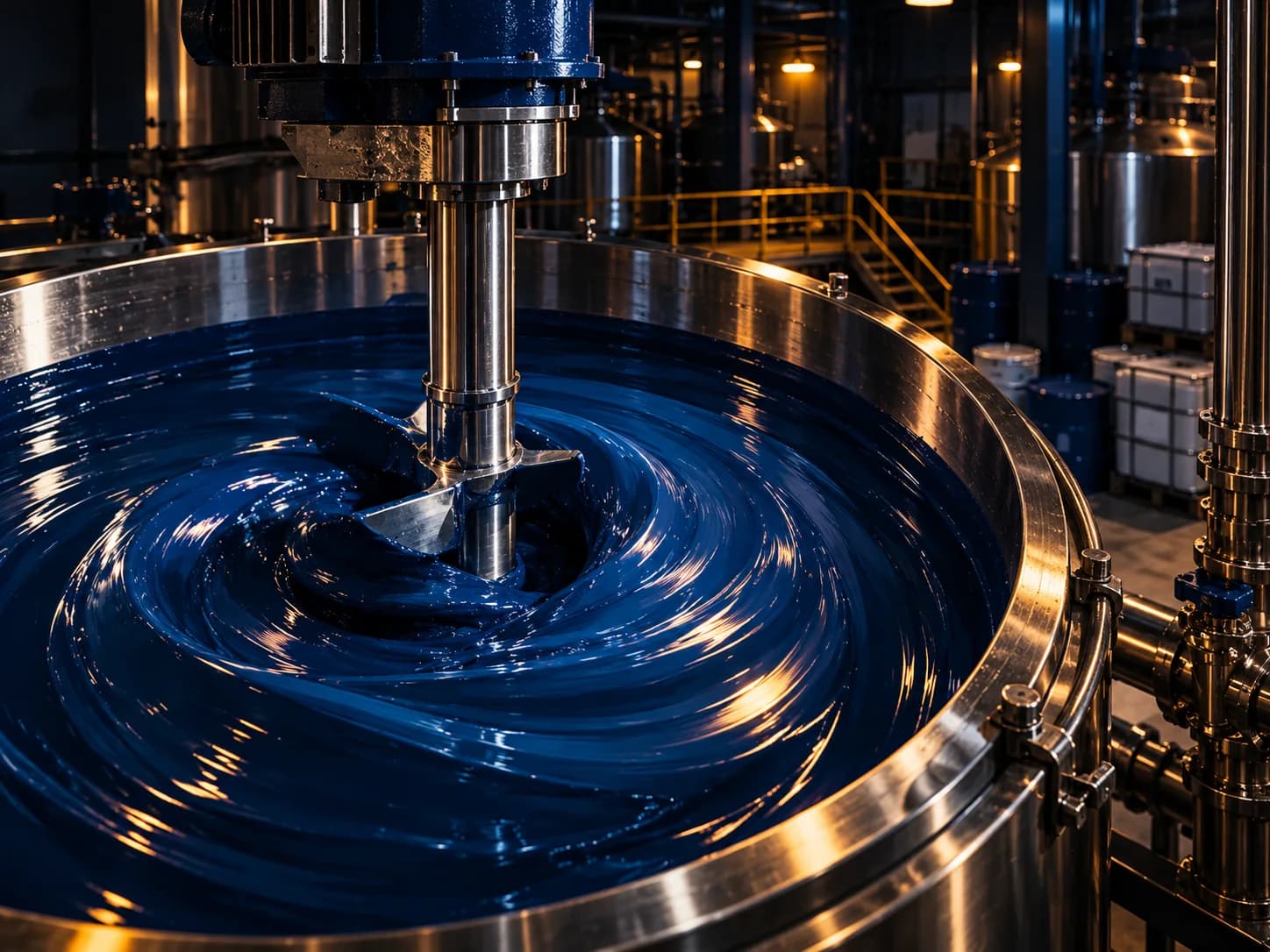
Every coat starts with the right raw material.
Industry 01 / 16
Paints & Coatings
Pigments, binders, driers, additives, fillers and solvents for makers of decorative paints, industrial and protective coatings, wood finishes, putty and inks across India, matched to your formulation.
A paint is only as good as what goes into it. Binder, pigment, filler, carrier and a few precise additives decide how a coat flows, hides, dries and lasts. We supply all five, matched to your formulation, so shade, viscosity and cost stay steady batch after batch.
- Products for this industry
- 208
- Product groups
- 37
- From categories
- 14
- With every batch
- COA & SDS
The anatomy of a can of paint
Every paint is built from five parts. Each has a clear job, and each is a raw material we can supply to your specification.
Binder
Forms the film and holds it to the surface
The resin or emulsion sets durability, adhesion and washability. Acrylic and styrene-acrylic emulsions carry water-based wall paints; drying-oil fatty acids build alkyds for enamels; epoxy curing agents harden two-pack protective coatings for steel, floors and concrete.
- 01
Binder
Forms the film and holds it to the surface
The resin or emulsion sets durability, adhesion and washability. Acrylic and styrene-acrylic emulsions carry water-based wall paints; drying-oil fatty acids build alkyds for enamels; epoxy curing agents harden two-pack protective coatings for steel, floors and concrete.
- 02
Pigments
Give colour, hiding power and protection
Rutile titanium dioxide gives whiteness and opacity, iron oxides and organic pigments give colour, and functional pigments work in the film: zinc phosphate and micaceous iron oxide protect steel, aluminium paste adds a metallic finish.
- 03
Fillers
Add body, control sheen and balance cost
Extenders such as calcite, talc and blanc fixe build solids and film thickness, help set the sheen level and reduce how much binder and pigment a formulation needs. Particle size and oil absorption decide how a filler behaves.
- 04
Carrier
Water or solvent that makes paint easy to apply
Water-based paints dry as water evaporates and the binder particles join into a film. Solvent-based enamels, primers and lacquers rely on aromatic solvents and blended thinners, chosen for evaporation rate, flow and the binder they must dissolve.
- 05
Additives
Small doses that fix specific problems
Driers cure alkyd films, thickeners stop sagging, dispersants keep pigment evenly spread, defoamers remove bubbles, anti-skinning agents protect the can and preservatives stop water-based paint spoiling in the tin or growing mould on the wall.
What a paints & coatings plant buys from us
Scroll through our product groups for this industry. The number on each tile is how many products we list in it.
- Products
- 208
- Groups
- 37
- Pigment Red 112
- Pigment Blue 15:3
- Pigment Green 7
- Pigment Violet 23
- OpOrganic Pigments & Pigment Pastes
- AdAdditives, Dispersants & Rheology
- RcResins, Binders & Curing Agents
- StSolvents & Thinners
- WfWhite & Functional Pigments
- PcPaint Driers & Catalysts
- CbChrome, Blue & Other Inorganic Pigments
- CcChromium, Copper, Cobalt, Nickel, Manganese & Zinc Compounds
- IoIron Oxide Pigments
- FiFillers, Extenders & Grinding Media
- MpMetallic Pigments
- FaFatty Acids, Glycerine & Oleochemicals
- 25OpOrganic Pigments & Pigment Pastes
- 23AdAdditives, Dispersants & Rheology
- 20RcResins, Binders & Curing Agents
- 17StSolvents & Thinners
- 14WfWhite & Functional Pigments
- 11PcPaint Driers & Catalysts
- 10CbChrome, Blue & Other Inorganic Pigments
- 9CcChromium, Copper, Cobalt, Nickel, Manganese & Zinc Compounds
- 8IoIron Oxide Pigments
- 8FiFillers, Extenders & Grinding Media
- 7MpMetallic Pigments
- 7FaFatty Acids, Glycerine & Oleochemicals
- Pigments & Colourants
- Paints, Coatings & Resins
- Solvents & Thinners
- Inorganic Salts & Metal Compounds
- Oleochemicals, Terpenes & Specialty Oils
Products buyers ask us for most
01What is the difference between water-based and solvent-based paint raw materials?
Water-based paints use acrylic or styrene-acrylic emulsions, dry as water evaporates and need a coalescent, a thickener such as HEC, a pH neutraliser and an in-can preservative. Solvent-based enamels and primers use alkyds or other resins dissolved in solvents or thinners, dry by solvent loss plus oxidation or chemical cure, and need metal octoate driers and an anti-skinning agent such as MEK oxime.
02What does PVC mean in a paint formulation?
Pigment volume concentration (PVC) is the share of pigment and filler in the dry paint film by volume. A higher PVC gives a flatter, more economical paint with lower washability, as in distempers and interior flats; a lower PVC gives more binder per particle, so the film is glossier, tougher and easier to clean, as in enamels and premium emulsions.
03How should emulsions, driers and fillers be stored?
Keep emulsions and water-based resins between frost and heat, because freezing can ruin them. Store solvent-based driers, resins and catalysts away from flames, sparks and direct sun. Keep powders such as HEC, talc and calcite dry, sealed and off the floor, and close drums after use to prevent skinning and moisture pick-up. Always follow the manufacturer's SDS.
04What should I send to get a quote for paint raw materials?
Send the product and the grade or make you use today, your end use (wall paint, enamel, putty or industrial coating), the specifications you check such as solids, viscosity, metal content or particle size, the quantity and monthly volume, your preferred pack and the delivery location. We confirm grade and make before quoting and ship the manufacturer's COA and SDS with every batch.
One partner for 16 industries
- 02Printing InksPigments, resins, solvents
- 03Plastics, Polymers & RubberStabilisers, modifiers, waxes
- 04ConstructionPolymers, silanes, admixture salts
- 05Adhesives & SealantsBinders, silanes, tackifiers
- 06Paper & BoardBinders, wet-end chemicals
- 07Water & WastewaterProgrammes, coagulants, biocides
- 08Oil & GasScavengers, brines, drilling aids
- 09PharmaceuticalsExcipients, intermediates, solvents
- 10Food & NutritionAcids, preservatives, minerals
- 11Personal CareEmulsifiers, actives, preservatives
- 12Home Care & DetergentsSurfactants, builders, actives
- 13Agriculture & FertilisersPhosphates, nitrates, chelates
- 14Glass, Ceramics & MetallurgyBorates, fluorides, ferro alloys
- 15Leather & TextilesChromium salts, oxidants, auxiliaries
- 16Lithium & Advanced MaterialsLithium & tungsten compounds










Tell us what your next batch needs.
Product, grade or make, quantity and delivery location are enough. We confirm the specification before we quote, and every batch ships with the manufacturer's COA and SDS.