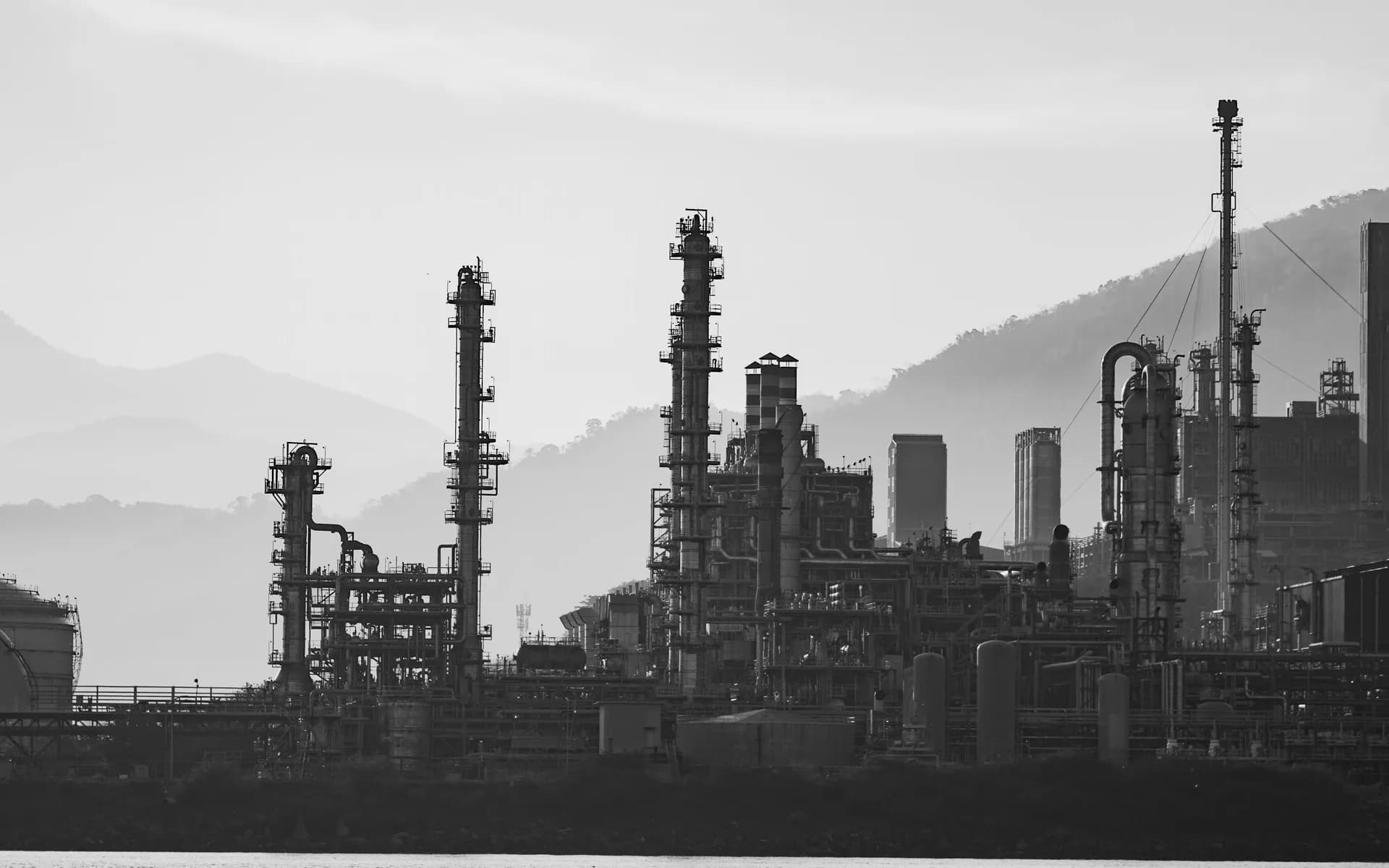
Down the hole, there is no second chance.
Industry 08 / 16
Oil & Gas
Drilling mud materials, completion brine salts, acidising chemicals, oxygen and H2S scavengers, gas-treating amines and glycols for operators, oilfield service companies, mud contractors, refineries and gas processing plants in India and abroad.
Oilfield fluids work under pressure, heat, salinity and sour gas, far below the surface where problems are hard to fix. A mud that loses density, a brine that crystallises or a scavenger that falls short costs rig time and well integrity. We supply drilling, completion, production and gas processing chemicals to the API grade or specification your programme sets.
- Products for this industry
- 81
- Product groups
- 26
- From categories
- 11
- With every batch
- COA & SDS
Five jobs across a well's life
Oil and gas chemicals follow the well from the first metre drilled to the gas leaving the plant. Each of these five stages needs its own materials, sourced to specification.
Drilling fluids
Carries cuttings and keeps the well in balance
Water-based muds use API bentonite for viscosity and a thin filter cake, barite to add density against formation pressure and xanthan gum for shear-thinning carrying capacity. Lignosulphonate thins and deflocculates the mud, and potassium chloride slows the swelling of reactive shales.
- 01
Drilling fluids
Carries cuttings and keeps the well in balance
Water-based muds use API bentonite for viscosity and a thin filter cake, barite to add density against formation pressure and xanthan gum for shear-thinning carrying capacity. Lignosulphonate thins and deflocculates the mud, and potassium chloride slows the swelling of reactive shales.
- 02
Completion brines
Solids-free weight for completion and workover
Clear brines hold well pressure without solids that could plug the reservoir. Potassium chloride, sodium chloride and sodium formate cover the lighter densities, calcium chloride and sodium bromide reach heavier ones, and blends fine-tune density and crystallisation temperature for conditions downhole.
- 03
Stimulation
Opens near-wellbore rock to restore flow
Acidising dissolves carbonate rock and the damage left by drilling. Hydrochloric acid does most of the work, formic acid reacts more slowly for hotter wells, and ammonium bifluoride in HCl generates the hydrofluoric acid that dissolves clays in sandstone. Corrosion inhibitors protect tubulars while acid is pumped.
- 04
Production water
Controls oxygen, H2S, bacteria and scale
Produced and injection water carry dissolved oxygen, hydrogen sulphide, bacteria and scaling ions. Bisulphite scavengers remove oxygen, triazine strips H2S from gas and liquids, glutaraldehyde controls sulphate-reducing bacteria, and phosphonates such as ATMP and DTPMP inhibit carbonate and sulphate scale in lines and wells.
- 05
Gas processing
Sweetens and dries gas to pipeline specification
Natural gas leaves the well wet and often sour. Amines such as MEA absorb hydrogen sulphide and carbon dioxide, triethylene glycol dries gas in contactor towers, monoethylene glycol prevents hydrate plugs in flowlines, and silica gel adsorbs moisture in solid-bed dryers.
What a oil & gas plant buys from us
Scroll through our product groups for this industry. The number on each tile is how many products we list in it.
- Products
- 81
- Groups
- 26
- Ammonium Bisulfite
- Sodium Bisulfite
- Sodium Metabisulfite
- Sodium Sulfite
- 17OiOil & Gas / Oilfield
- 9CtCooling Tower Treatment
- 6BwBoiler Water Treatment
- 5DcDescaling & Cleaning Chemicals
- 5CiCorrosion Inhibitors
- 5RmRaw Materials for Water-Treatment Formulations
- 4StSolvents & Thinners
- 4SpSpecialty Inorganics
- Oil & Gas / Oilfield
- Water Treatment Programme Chemicals
- Solvents & Thinners
- Specialty Inorganics & Chemical Intermediates
Products buyers ask us for most
01Why is potassium chloride added to water-based drilling muds?
Potassium chloride inhibits reactive shales. Potassium ions exchange with sodium and other hydrated cations on clay surfaces and, because they fit closely into the clay structure, reduce how much water the shale takes up, so it swells, softens and sloughs less. KCl muds are usually combined with polymers such as xanthan gum. The right concentration depends on the shale's clay mineralogy and is set by mud-engineering tests, since more is not always better.
02What is the difference between MEA and TEG in gas processing?
They remove different things. Monoethanolamine (MEA) is an amine that chemically absorbs the acid gases hydrogen sulphide and carbon dioxide to sweeten sour gas, and the rich amine is regenerated by heating in a stripper. Triethylene glycol (TEG) is a hygroscopic liquid that absorbs water vapour in a contactor to dry gas and prevent hydrates and corrosion; it is regenerated in a reboiler at around 200 °C. A plant treating sour, wet gas often needs both.
03When is formic acid used instead of hydrochloric acid for acidising?
Formic acid is chosen when hydrochloric acid would react too fast or corrode too much. As a weaker organic acid it reacts more slowly with carbonate and is easier to inhibit at high temperature, so it suits hot wells, deeper live-acid penetration and long acid contact with tubulars. Its strength is limited because calcium formate can precipitate at higher concentrations, so formic acid is used at lower strengths than HCl, sometimes blended with it.
04Why does sandstone acidising need ammonium bifluoride as well as HCl?
Hydrochloric acid dissolves carbonates but not the clays, feldspars and fine silica that block pore throats in sandstone; only hydrofluoric acid does that. Ammonium bifluoride dissolved in HCl generates HF within the acid, avoiding the handling of concentrated HF, to make mud acid such as 12% HCl with 3% HF. An HCl preflush removes carbonates first, because calcium reacting with HF forms insoluble calcium fluoride that can damage the formation.
One partner for 16 industries
- 01Paints & CoatingsPigments, binders, driers, additives
- 02Printing InksPigments, resins, solvents
- 03Plastics, Polymers & RubberStabilisers, modifiers, waxes
- 04ConstructionPolymers, silanes, admixture salts
- 05Adhesives & SealantsBinders, silanes, tackifiers
- 06Paper & BoardBinders, wet-end chemicals
- 07Water & WastewaterProgrammes, coagulants, biocides
- 09PharmaceuticalsExcipients, intermediates, solvents
- 10Food & NutritionAcids, preservatives, minerals
- 11Personal CareEmulsifiers, actives, preservatives
- 12Home Care & DetergentsSurfactants, builders, actives
- 13Agriculture & FertilisersPhosphates, nitrates, chelates
- 14Glass, Ceramics & MetallurgyBorates, fluorides, ferro alloys
- 15Leather & TextilesChromium salts, oxidants, auxiliaries
- 16Lithium & Advanced MaterialsLithium & tungsten compounds









Tell us what your next batch needs.
Product, grade or make, quantity and delivery location are enough. We confirm the specification before we quote, and every batch ships with the manufacturer's COA and SDS.