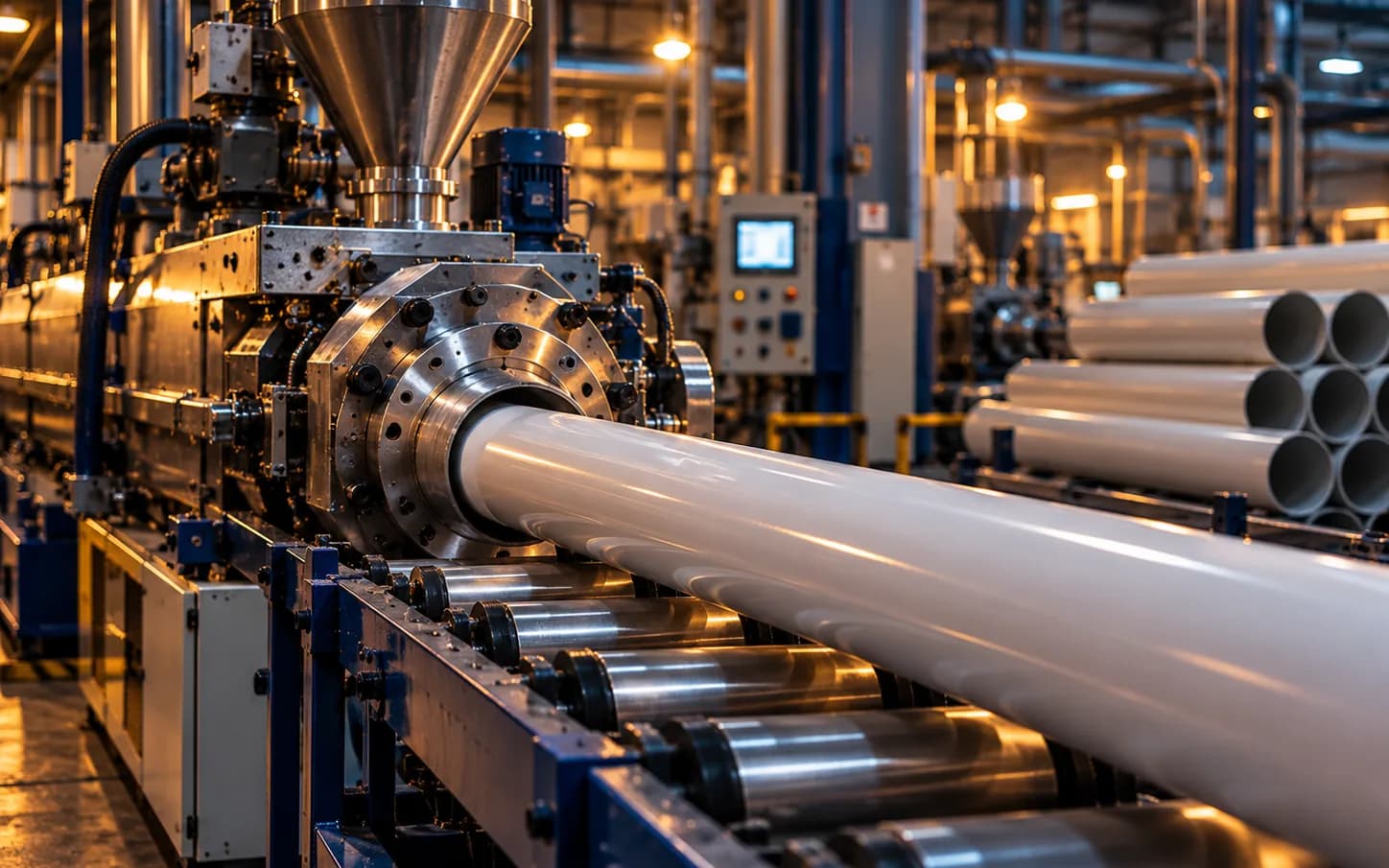
Built to survive the extruder, then the sun.
Industry 03 / 16
Plastics, Polymers & Rubber
Heat and UV stabilisers, antioxidants, impact modifiers, processing aids, waxes, plasticisers, pigments and rubber chemicals for makers of PVC pipe and profile, film, masterbatch, cables, mouldings, tyres and rubber goods across India.
A polymer faces its hardest tests twice: in the heat and shear of the extruder, and in years of sunlight and service. Stabilisers, modifiers, lubricants, fillers and curatives decide whether a pipe, film or tyre passes both. We supply these raw materials for plastics and rubber, grade-matched to your process before quoting, with batch traceability on every lot.
- Products for this industry
- 155
- Product groups
- 39
- From categories
- 13
- With every batch
- COA & SDS
The anatomy of a plastic or rubber compound
Whether it becomes a PVC pipe, a PE film or a tyre tread, a compound is built from five parts, each with a clear job and each a raw material we supply.
Stabilisers
Protect the polymer from heat, oxygen and UV
PVC starts to break down at processing temperatures, so tin or lead-free calcium-zinc stabilisers go into pipe, profile, sheet and cable. Polyolefins, nylon and ABS take phenolic and phosphite antioxidants to survive the melt and long service, plus UV absorbers and HALS for outdoor life.
- Tin Stabilizer — Mark 1984E (Methyl Tin)
- Ca-Zn Stabilizers — CZ-328 / 576 / 978 / 701 / 702 / 1522 / 1442 / 1478 / 1496 / 2122S
- Antioxidants — Rianox 1010 / 1076 / 1098 / 168 / MD-1024 / 330 / 626 / 1130 / 3114 / DSTP
- UV Absorbers — Riasorb UV-P / 531 / 326 / 234 / 328 / 329
- Hindered Amine Light Stabilizers — Riasorb UV-770 / 622 / 944 / 119S
- 01
Stabilisers
Protect the polymer from heat, oxygen and UV
PVC starts to break down at processing temperatures, so tin or lead-free calcium-zinc stabilisers go into pipe, profile, sheet and cable. Polyolefins, nylon and ABS take phenolic and phosphite antioxidants to survive the melt and long service, plus UV absorbers and HALS for outdoor life.
- Tin Stabilizer — Mark 1984E (Methyl Tin)
- Ca-Zn Stabilizers — CZ-328 / 576 / 978 / 701 / 702 / 1522 / 1442 / 1478 / 1496 / 2122S
- Antioxidants — Rianox 1010 / 1076 / 1098 / 168 / MD-1024 / 330 / 626 / 1130 / 3114 / DSTP
- UV Absorbers — Riasorb UV-P / 531 / 326 / 234 / 328 / 329
- Hindered Amine Light Stabilizers — Riasorb UV-770 / 622 / 944 / 119S
- 02
Modifiers
Add toughness, melt strength and flexibility
Acrylic, MBS and CPE impact modifiers stop rigid PVC cracking under impact, and acrylic processing aids speed fusion and add melt strength for pipe, profile and foam board. DOP plasticises flexible PVC for cables, film and hose, with ESBO as a secondary plasticiser and heat co-stabiliser.
- 03
Lubricants
Help the melt flow and release from hot metal
Calcium stearate and glyceryl monostearate ease flow inside the melt, while polyethylene and Fischer-Tropsch waxes work at the metal surface to control fusion and release. Film makers add slip agents to lower friction between layers, and zinc stearate serves as a lubricant and mould release in PVC and rubber.
- 04
Colour & fillers
Give colour, opacity, brightness and body
Plastics grades of rutile titanium dioxide give opacity in masterbatch, profiles and film, phthalocyanine and pre-dispersed pigments colour polyolefins and PVC, and polymer-soluble dyes tint clear PS, PC and PET. Optical brighteners lift whites, while calcite adds body and stiffness and reduces the resin needed per kilogram.
- 05
Rubber curing
Reinforce rubber and cross-link it into shape
Sulphur cross-links rubber during vulcanisation, while zinc oxide and stearic acid activate the accelerator so the cure is fast and efficient. N-330 carbon black reinforces tyre treads and moulded goods, zinc carbonate serves as a transparent activator, and resorcinol-based resins help bond rubber to tyre cord.
What a plastics, polymers & rubber plant buys from us
Scroll through our product groups for this industry. The number on each tile is how many products we list in it.
- Products
- 155
- Groups
- 39
- Pigment Blue 15:3
- Pigment Green 7
- Pigment Violet 23
- Pigment Rubine Toner
- OpOrganic Pigments & Pigment Pastes
- WfWhite & Functional Pigments
- CiChemical Intermediates
- StSolvents & Thinners
- MpModifiers, Processing Aids & Resins
- MsMetallic Stearates & Processing Additives
- FiFillers, Extenders & Grinding Media
- CtCooling Tower Treatment
- IoIron Oxide Pigments
- RcResins, Binders & Curing Agents
- AdAdditives, Dispersants & Rheology
- PfPharma, Food & Specialty Chemicals
- 13OpOrganic Pigments & Pigment Pastes
- 12WfWhite & Functional Pigments
- 11CiChemical Intermediates
- 10StSolvents & Thinners
- 9MpModifiers, Processing Aids & Resins
- 8MsMetallic Stearates & Processing Additives
- 6FiFillers, Extenders & Grinding Media
- 6CtCooling Tower Treatment
- 5IoIron Oxide Pigments
- 5RcResins, Binders & Curing Agents
- 5AdAdditives, Dispersants & Rheology
- 5PfPharma, Food & Specialty Chemicals
- Pigments & Colourants
- Specialty Inorganics & Chemical Intermediates
- Solvents & Thinners
- Plastics & Rubber Additives
- Paints, Coatings & Resins
- Water Treatment Programme Chemicals
- Pharma, Food & Specialty Chemicals
Products buyers ask us for most
01Why are zinc oxide and stearic acid both added to sulphur-cured rubber?
Together they form the activator system for sulphur vulcanisation. Zinc oxide supplies zinc, and stearic acid reacts with it to form zinc stearate, which dissolves in the rubber. This zinc complex works with the accelerator to make sulphur cross-linking faster and more efficient, so the compound reaches a good state of cure in less time. Recipes commonly use a few parts of each per hundred of rubber, set by the compound design.
02What is the difference between internal and external lubricants in PVC?
Internal lubricants are polar and compatible with PVC: they reduce friction between polymer chains, lower melt viscosity and promote fusion. External lubricants, such as paraffin, polyethylene and Fischer-Tropsch waxes, are mostly non-polar, move to the melt surface and reduce sticking to hot barrels, screws and dies, which delays fusion. Rigid PVC needs the two in balance: too much external lubricant gives poor fusion and plate-out, too little causes sticking and burning.
03How do slip and antistatic additives work in PE and PP film?
Both migrate, or bloom, to the film surface after extrusion. Slip agents, usually fatty amides such as erucamide or oleamide, form a thin lubricating layer that lowers the coefficient of friction so film runs smoothly on bag-making and packing lines; erucamide blooms more slowly than oleamide. Antistatic agents such as glycerol monostearate or ethoxylated amines draw a thin layer of moisture to the surface that dissipates static, reducing cling and dust pick-up.
04Why is titanium dioxide for plastics different from paint-grade TiO₂?
Plastics grades are designed for hot, dry polymer melts rather than water or solvent. They carry lighter surface treatments, often with an organic coating, so they disperse well in polyolefins and PVC and release little moisture at processing temperatures. Moisture from heavily treated grades can cause lacing, small holes in thin film. Paint grades carry heavier treatments for dispersion and durability in a liquid coating. Choose by polymer, processing temperature and outdoor exposure.
One partner for 16 industries
- 01Paints & CoatingsPigments, binders, driers, additives
- 02Printing InksPigments, resins, solvents
- 04ConstructionPolymers, silanes, admixture salts
- 05Adhesives & SealantsBinders, silanes, tackifiers
- 06Paper & BoardBinders, wet-end chemicals
- 07Water & WastewaterProgrammes, coagulants, biocides
- 08Oil & GasScavengers, brines, drilling aids
- 09PharmaceuticalsExcipients, intermediates, solvents
- 10Food & NutritionAcids, preservatives, minerals
- 11Personal CareEmulsifiers, actives, preservatives
- 12Home Care & DetergentsSurfactants, builders, actives
- 13Agriculture & FertilisersPhosphates, nitrates, chelates
- 14Glass, Ceramics & MetallurgyBorates, fluorides, ferro alloys
- 15Leather & TextilesChromium salts, oxidants, auxiliaries
- 16Lithium & Advanced MaterialsLithium & tungsten compounds



Tell us what your next batch needs.
Product, grade or make, quantity and delivery location are enough. We confirm the specification before we quote, and every batch ships with the manufacturer's COA and SDS.